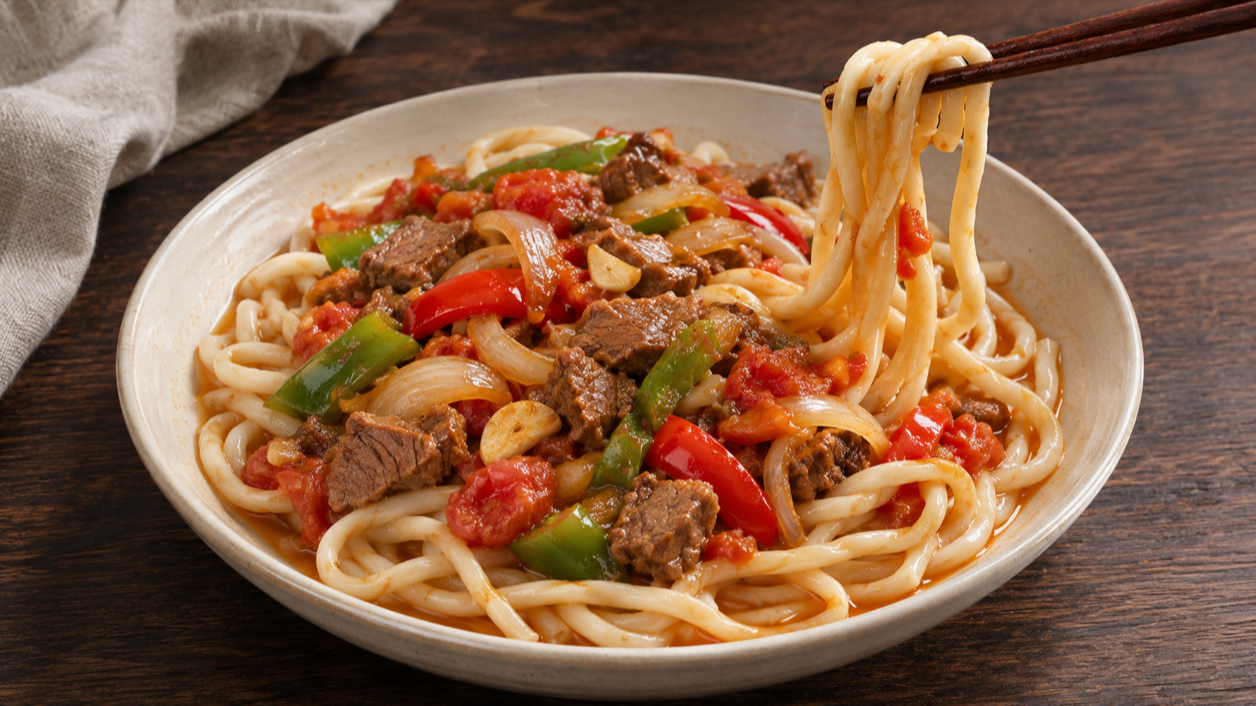
A strand of laghman can make you reconsider how far a fork ought to travel. Lift a little coil from the plate and another loop comes with it, then another. Below, there’s a stir-fry of peppers, tomatoes and browned meat. The best bite has some of each, which is easier said than done when the noodle is still unspooling.
Laghman, also spelled lagman, is a staple of Uyghur cooking. A classic plate starts with hand-pulled wheat noodles, boiled until supple and topped with a stir-fry. Tomatoes lend a bright tartness, green peppers keep a bit of snap, and mutton or lamb gives the sauce depth. The proportions can change with the cook. What you notice first, even through a generous helping of sauce, is how much the noodles give you to chew.
How the noodles get their bounce
Before they’re long enough to cause trouble at the table, the noodles can look like a tidy coil of rope. In one Uyghur home-cooking demonstration, the cook rolls the dough into lengths, oils them so they won’t stick, and coils them up to rest. Then comes the pull. The cook rolls and stretches each length between the hands, keeping the strand even so it cooks at the same rate from end to end. A cook can make the movement look wonderfully casual. That’s a sign of practice.
You can tell what all that work was for once the noodles are cooked. A strand bends easily around a fork and still gives a little push back when you bite. The noodle itself tastes gently of wheat, which leaves room for the garlic and peppers to come through. And because a long strand slips through more than one part of the plate, a bite can start with the sharpness of tomato and finish with the savor of browned lamb. The same bowl can taste a bit different two forkfuls in a row.
The stir-fry changes with the table
In her fieldwork in Ürümqi, anthropologist Maria Cristina Cesaro described laghman as everyday food and noted that the stir-fried topping could include tomatoes, green peppers, mutton and other vegetables. That last bit leaves plenty of room for the cook. Soft onion and mushroom make for a mellow, savory forkful. A green pepper with a little crunch reminds you how much the vegetables are doing, even in a mouthful full of meat and noodles.
It’s the vegetable combination that catches the eye in the Royal Laghman at Dolan Uyghur Restaurant in Falls Church, Virginia. The kitchen pulls its noodles fresh and tops them with tomatoes, red and green peppers, onions, cabbage, mushrooms and house sauce. Beef is one of the options. There’s a lot going on in that stir-fry, from the sweetness of the onions to the softer bite of the mushrooms. Dolan says its entire food menu is halal.
When the beans were ripe
Laghman is familiar in Uyghur communities across Central Asia, and the name carries a possible clue to the culinary exchange behind it. One connection Cesaro considers is the Chinese lāmiàn, a name for pulled noodles. It’s a fitting possibility for a dish whose defining feature is the way the dough is stretched. What goes over those strands can be much more local, right down to which vegetables are ready that week.
In their research on Uyghur women’s chay gatherings in Kazakhstan, Rachel Harris and Zulfiyam Karimova record one recollection of the older generation getting together for laghman when the beans were ripe. When pumpkins came in, the gathering centered on manta, or dumplings. It’s a lovely way to remember a growing season, one meal at a time.
The same noodle, straight into the wok
At Turan Uyghur Kitchen in Plano, Texas, the menu gives you two chances to get acquainted with that chew. There’s the Uyghur Laghman, and there’s Korma Chop, which takes hand-pulled noodles into the wok with beef, bell peppers and chives and finishes them with sesame seeds. Turan describes its Plano menu as fully halal, and Halal Monitoring Services lists the branch’s beef, lamb and chicken as certified.
The two dishes make a good pair because the noodles meet the sauce at different moments. With topped laghman, the first few strands you lift from the edge might still be pale, with most of the good juices waiting underneath. With Korma Chop, the noodles cook in the stir-fry and come out already coated. The peppers and chives get tucked between them, and the sesame seeds add a small crunch to that springy bite. You can get absorbed in the differences, or you can just agree that ordering both was a good idea.
Back at the laghman plate, the last few loops are often the best part. They’ve had time to sit in the juices while you’ve worked your way through the peppers and meat. There might be a soft bit of onion left, or one little piece of tomato that can still be coaxed onto a fork. After all that winding and unwinding, the plate goes quiet pretty quickly.